Thursday, 15 March 2012

Digital watch.

So, those digital switchover ads. They've been going on for a while.

Have a guess at how long. Two years? Three? Nowhere near. In fact, the cute little robot (named, amusingly, Digit Al) has been on our screens since 2006.

So, as the last two areas in the UK, London and The Channel Islands, get ready to switch over, I thought I'd offer my own end-of-campaign report.

Was it any good?

It's all rather subjective. I quite liked Al and the tone was suitably soft and comforting, I mean, he's no Monkey (even though they did make a cuddly Digit Al toy) but then he didn't have to be.

In his 2006 incarnation, Al (played by Matt Lucas) was the voice as well as the face of the digital switchover. It didn't really work - too bolshy, too "Wahey! Digital switchover! Mental!" A bit of a turn-off for the elderly - who, after all, were a massively important audience (and he had scary illuminated eyes.)
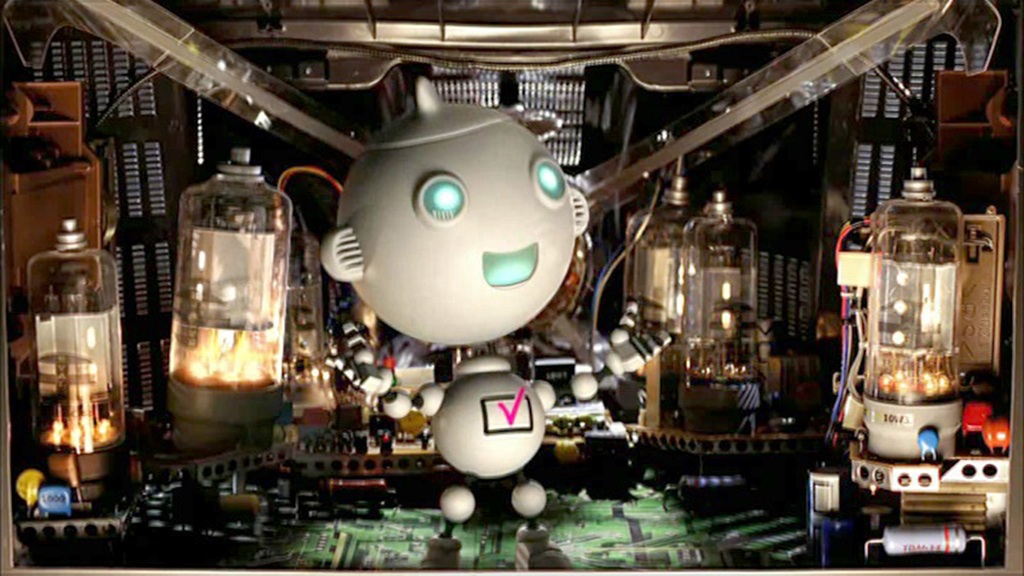


And here he is being all cute and reassuring (aahhh, look at the eyes. How sweet). And not actually talking, which is good.
 

I know which one I prefer.

But did it work?
Let's have a look at the (highly anecdotal) evidence. In a sense, the campaign's success can only be judged by the number of complaints the switchover received. The fewer complaints, the greater the success.
A quick glance at The Daily Hysteria Mail website reveals no disaster stories of grannies being left to die because their TV's were still analogue and they couldn't watch Eastenders. Or something. So that's a good thing.
But contrast this with the early days when doom-mongers and naysayers were predicting widescale televisual carnage.
"Nearly a third of the population has no idea what to do to continue watching television after the analogue switch-off...This is a recipe for confusion," shrieked Edward Leigh, Conservative chairman of the committee of public accounts in this article from 2008. "It certainly suggests a lot of screens will go blank after the switchover."
Well, they didn't. It seems the constant flow of TV spots, press ads, DM packs and online activity really did work. Which is why I give the whole campaign a nice big (digital) tick.


Now let's see how they handle the radio...

TV is changing...

This week's guest post comes from Mike Colling, Managing Director at MC&C...

Last week I was invited to give a future gazing presentation on 'Convergent Evolution and The Growth of TV' or 'What's next for Media?'

It's not all about online. Print may be dying but TV isn't dead (in fact it's thriving). As I'm sure we all know, conventional TV viewing is going from strength to strength.

In 2000 the average UK adult watched 3.7 hours of TV a day. Now that we spend another 2 hours a day watching online as well, our viewing takes up 4 hours of our day.

This is partially driven by the fact that we all have access to much more TV - more stations, more hours and the blessed convenience of Sky+ and TiVo.

But it's also driven by the fact that we humans prefer the passive consumption of audio/visual to print, and it's that pressure that's driving convergent evolution. 

Confession time - in my youth I was a zoologist, so I bring that heritage to my view of the media world.

Convergent evolution is when evolutionary forces change two distinct species so they resemble one another (because their new form is the most efficient way for them to thrive and survive).

So I see convergent evolution at play in media - with what once were distinct media channels beginning to resemble and mimic TV.

Here's a magazine example: HEAT 

And here's a poster example: POSTER

Both of them taking on the guise of TV.

This is a key trend I expect to continue to accelerate. TV will become more widely distributed and more media channels will change to look like TV. Already 45% of internet traffic is video, and that is expected to hit 90% by 2014.

This brings great advantages - we'll see much better engagement and response rates from the places and times we've succeeded in before.

However, it does bring creative challenges - a conventional 30" spot or 90" DRTV ad won't work on a poster and it will challenge response - what do you ask the viewer of an ad on a tablet on a train to do? And as far as measurement challenges go - how do you build your ROI case?

But challenges aside, this is exciting.

Evolutionary forces bring new species. It looks like TV, consumers think it's TV, but it's not quite the same. I love change, don't you?
www.mcand.co.uk


Thursday, 8 March 2012

Good game, good game.

It's 12:56am. You're on your 17th round of Bejeweled Blitz. You're about to smash your top score. Eyes sore, thumbs numb, you've done it. You're onto Level 18!

"I can do this. Just a few more levels, then I'll go back to bed".

Your bedside clock bleeps. It's 1am. Reality slaps you round the face and you ask yourself that all-too familiar question...

"What the **** am I doing with my life?"

Hey sad guy, it doesn't have to be this way. What if little-old-gaming-addict you could enjoy hours of online fun and make a positive difference at the same time? That dull sense of self-loathing could be a thing of the past. You could genuinely feel as though you've spent time doing something productive, enriching and selfless, while all the time having an absolute riot.

And when it comes to making a positive difference, there's nothing like finding a cure for cancer, right? I mean, that's the biggie.

Introducing Foldit; the online protein-folding game in which players use their skills to help solve critical problems in world health. Introductory puzzles teach players the rules and the 'basic' (ha!) laws of physics that dictate how protein strands curl and twist into 3D shapes. You then increase your 'Global Evolver Score' by solving the puzzles, creating your online profile and chatting to other players.

Up until now, traditional protein prediction software has been used to help scientists look at every configuration and the biological role it could play in fighting disease. Just using computer software, this is a mammoth task predicted to take hundreds of years. So scientists are asking the question, can humans get to the answer quicker?

And what do you know? It looks like we can. Researchers recently invited gamers to use the platform to compete in configuring an HIV/AIDS related retrovirus (the Mason-Pfizer monkey virus to be exact). Those clever gamers took just ten days to produce a 3D model of the enzyme, something that has stumped scientists for 15 years. When a high-scoring 13 year-old (going by his Foldit alias of 'Cheese') was asked about his method, he simply shrugged and said 'it just looks right'. Looks like 2011's answer to Tetris has uncovered the next protein-folding prodigy...

When it comes to gaming for good, Foldit has it nailed. Although it does take a while to get your head around hydrogen bonds and hydrophobic patches, there's definitely something satisfying about the process. After playing for just 15 minutes I'm onto puzzle 16 of 32, and although I'm feeling a bit smartypants, I'm certainly no match for 'Cheese' yet. When I've found the cure for Alzheimer's though, I'll give you a shout.

As so elegantly put by techcrunch.com, "If you're going to waste your life playing games on Facebook, you might as well help the world while you're at it."

So stop mowing your farm, quit mining for diamonds and leave those birds alone. It's time to game for the greater good.


Wednesday, 7 March 2012

Meet the New CRM.

Ask yourself, how much does social CRM really differ from what's gone before?

The tech may be different, but at the heart of these approaches is the desire to create a lasting loyal relationship with the customer. There are however, some key elements to social that are different from what we've seen before.

Elements such as brand control, amplification effect and the speed with which a message is spread have obviously been affected. But who we're now competing against in this market? That's very different. If we decide to enter the social sphere we're not competing for a share of wallet, we're competing for attention.

In 2010 the CEO of Google Eric Schmidt said: "Every two days we create as much information as we did from the dawn of civilisation up until 2003."

This drives the first principle of social; be interesting. While this may be blindingly obvious, if we're not interesting then our customers will just go elsewhere. It's not as if there isn't enough stuff out there to keep them interested, even if 90% of it is crap.

It's amazing how many times you'll hear marketing people say "how can we use social to get our message out?", as if what they have to say is intrinsically interesting. To put my point another way (paraphrasing Howard Gossage): "People use social media to engage with what interests them. Every so often that can be you."

OK - so you've made sure you're interesting. What's next? 

Social by it's very nature is conversational - but not necessarily a conversation. Unlike in traditional CRM techniques, we must be prepared to talk with our customers - not at them. We can't just push messages out there and expect our audience to appreciate them. We have to be both a leader and a follower.

When it's appropriate we can lead, whether it's seeding the conversation amongst the community, adding value or helping customers achieve something they couldn't do before. A great example of this is how Adobe used Facebook to create a thriving community amongst its Photoshop user base (www.facebook.com/photoshop).

And while we're pushing messages out there, we also need to be listening (understanding who's saying what, when, where and how). As the old adage says, we're at least three times more likely to talk about a bad experience than a good one. With social it's all out there. If we piss someone off, we should expect to see it on some form of platform pretty sharpish. In the social world it's how we handle this that makes the difference between success and failure.

If we try to stifle criticism we're doomed to fail. One deleted comment leads to a re-posted comment, citing the original complaint and then some. It can start to snowball very quickly. It would be better to see this as an opportunity.

We have to accept that we are just a small part of the customer's brand perception. In the past we had no idea if Brian told Angela that he received terrible service, unless Brian also complained directly. At least now we can see our customer's concerns. Even if we don't think they really have the right to complain, at least there's the opportunity to solve the problem in the public arena - potentially gaining more than we stand to lose in the process.

And this is where the listening counts. There are now tools that allow businesses to monitor what's being said about them in the social sphere. When a problem arises and we're listening, we can engage with it before it gets out of control (and get to do so in a visible way).

With old CRM we'd listen to customers when we needed to. We'd do these things to create engagement. Now we listen to customers with social media as well as in person. We talk with them through social as well as on the phone. And in doing so we create stronger relationships.

The principles really aren't as different as we might have first thought they were. And if we start our planning from that perspective, then there's a fair chance that we'll get our use of social right.

Monday, 27 February 2012

Very Pinteresting.

According to recent facts and figures, 80% of up-and-coming 'social pinboard' Pinterest's users are women. Apparently something to shout about in the manly world of online, it's got the rest of the internet stroking their beards trying to figure it out. Why don't men like it as much? What is it about the gender-neutral site that has appealed so strongly to the girls?

I'll tell you what.

Mood boards.

It's a never-ending online collection of our very own curated tastes, desires and aspirations. Have you ever read a magazine for ladies? It's a big ol' mood board of expensive clothes, blue make-up and ugly £100 cushions, all stuck together by manicured women in a posh office.

But with Pinterest, the fairer (and more creative) sex can cultivate their own aesthetic. Push off Marie Claire/Elle/Vogue. We can collect our own ideas. We can arrange them in a stylish way for future reference on that inevitable miraculous day when we decide to make our lives prettier, smarter, better etc.

Women can connect with, share and display their creativity. And it's a powerful force to be reckoned with; Pinterest drives more traffic than YouTube, Reddit, Google+, LinkedIn and Myspace (and is visually much more stimulating that the powerhouse that is Twitter).

It's scrapbooking without the Pritt Stick.

It's a glossy mag without irritating diet tips.

It's style, dictated by the individual.

It's what women want, boys.


Tuesday, 7 February 2012

Stop using the force.

Yes, I've seen it. We've all seen it. Star Wars is good.

Well done George Lucas.

But when did this happen?

Star Wars
n (functioning as singular)
   1. lazy way to inject some sense of (perceived) awesomeness into your ad.
   2. an expensive way to align yourself with 40 year old men.

Last year saw baby Darth Vader go viral for Volkswagen after the Superbowl. Rightly so, he was damn cute.

This year Volkswagen had a fat dog that wanted to lose weight. The dog lost weight, was happy, whooshy shot of car, end of ad...right? Wrong. Volkswagen couldn't quite let go, and tagged on a pointless bar scene set on the Death Star. Que?


And then there's Currys, who made the most of Darth Vader's extensive (if a bit, you know, murder-y) skill set by hiring him as their HR representative last Christmas.


Star Wars, as we all know, was set at Christmas. It was of course loosely based on the story of Frosty the Snowman. Except that in Star Wars, Frosty the Snowman gets all burnt and goes all crossface helmet head.

Oh, and now we have Vodafone, who have commendably used YODA in their ads and admirably not called anything YODAFONE. Things have got a bit rubbish for poor old Yoda, who now frequents his local Yo Sushi, pestering boring couples who play with their phones at the table and wonder if people taste of the foods that their skin is the colour of. Bit racist.


Please stop using the force. It is weak in this one.


Monday, 6 February 2012

Notre voyage à Paris

 Last Tuesday, we all headed for Paris on the Eurostar...

Aren't we lucky?

After arriving at Gare du Nord, we headed for Bastille (where we were treated to lunch) before heading our separate ways to make the most of the few hours we had before our evening train home.

Invariably, high jinks ensued.

Some of our collective top moments were:

-  the chocolate mousse at lunchtime
-  trying to speak French and failing
-  all the non-smokers smoking for the day
-  dancing in the street 
-  spending quality time with each other (awww...)
-  Dom borrowing a busker's accordion and playing the Tetris theme
-  cornering a random woman on the train home and making her sing the hits of Shania Twain
-  two TBCHers not being allowed on the 9:15pm train home...and then somehow managing to get on at about 9:14pm.

Obviously, there are stories that continue on and beyond the 9:15pm train home...but I'm not going to tell you those, am I?